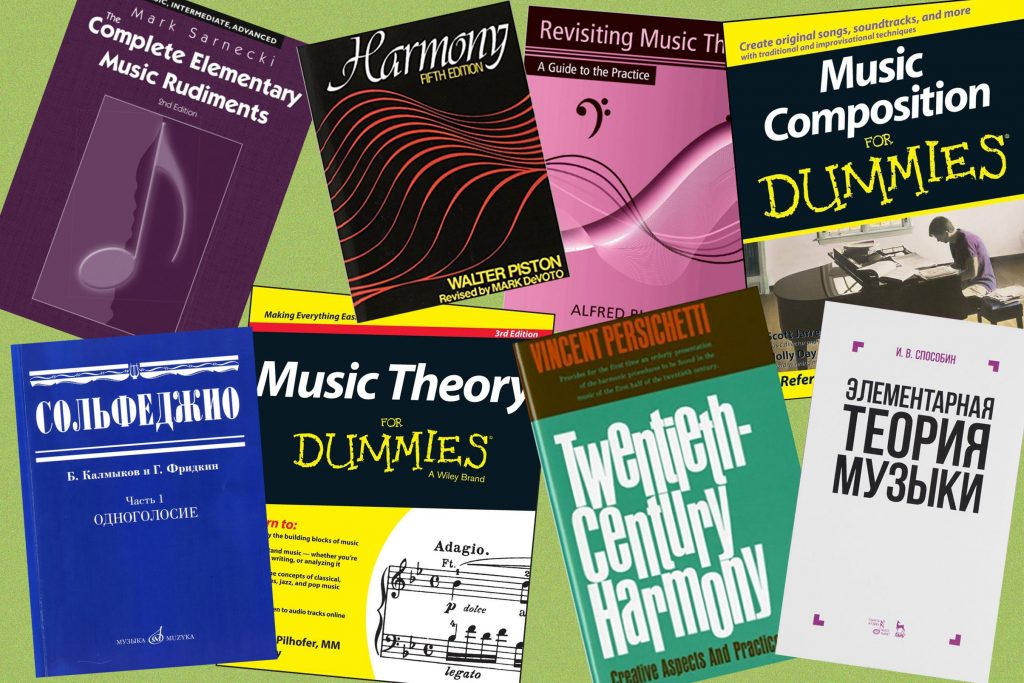
To tell the truth, music theory is the area where you can never feel safe enough. In my experience, you can always run into a person who is much more educated in a specific subject of the music theory than you are. It can be a bow technique of a 17th century Baroque ensemble, or the use of a diminished fourth in the symphonies of Shostakovich, and you may feel like an absolute dummy while discussing the subject. Does that mean that a composer should quit on mastering his knowledge of music theory and rely purely on inspiration? Absolutely not. The craft of composing music entails excelling proficiency in music theory. The more you know about the genres and techniques of the past centuries, the more diverse your music will become. The more you learn about the contemporary trends in world music, the more chances you have to be in demand.
In the endless field of music theory you will consider beginning with the following basics:
- Musical notation
- Scales
- Modes
- Enharmonic equivalents
- Clefs
- Tempos and time signatures
In case you have developed a firm knowledge of the above, you will progress with:
- Harmony
- Form and structure
- Timbres
- Orchestral and world instruments
- Transposing instruments
- Orchestration
Finally, please consider the subjects which will most probably open the doors to the world of sought-after composers, be it music for film and TV, or a commission by an orchestra:
- Music history
- Music analysis
- Music genres
- Music of the 20th century
- Contemporary trends in classical and world music
The three clusters of knowledge mentioned above are not complete and are based exclusively on my own experience. Each topic is only the top of the iceberg and may have a deep structure under it. In my day, the basics of musical knowledge were taught in the music schools of Russia. Together with some piano practice, my daily routine was filled with solfeggio (basic music theory) and musical notation. Later on, I studied the second and the third groups of the above mentioned subjects on my own. However, in case I wanted to continue my music education, I was welcome to take exams and enter a musical college, where I would study the second and third clusters of the above list, supervised by distinguished professors. In a conservatory, where I could continue my education later, I would study the same subjects, presumably at the deeper level.
It is always a good idea for a beginning composer to take a course in music composition at a conservatory or university. And yes, it is always good to be supervised by an experienced professor when you do research in any of the subjects. However, judging from my own experience, it is also possible to study the music theory by yourself. In the latter case, I would recommend a beginning composer to acquire confident knowledge in the mentioned elements gradually, beginning with musical notation and scales and proceeding through the harmony and structure to the perfection in music history and music analysis. Even if self-education requires more of your time than it would take at a conservatory, you can keep to your own pace and study more areas of music theory than may be covered by a university course or a conservatory program. The more knowledge you have, the more employable you become. It is true that some of the most important craft skills come to a composer with practice. However, a solid theoretical foundation will let you build an incredibly high and stable structure of your own music, which will not only be admired by an audience, but will hopefully let you obtain a sound and constant revenue.
If you ask me what book I would recommend to improve your knowledge of music theory, I would definitely refer to ‘Revisiting Music Theory: A Guide to the Practice’ by Alfred Blatter (2007, New York: Routledge).
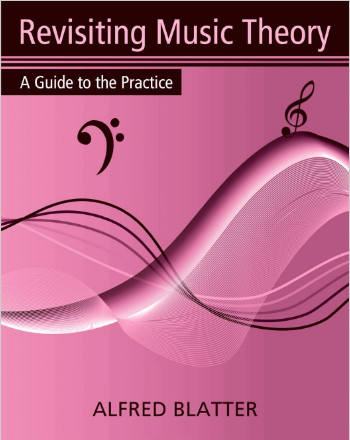
You can read it even if you are making the first steps in music theory. Believe it or not, after reading it from beginning to end you will definitely become an expert in the subject. Most of the above mentioned topics are explained here with every possible detail and with reference to music history. You may especially like it if you are fond of reading dictionaries (I used to enjoy reading dictionaries many years ago, and I still feel respect to people who enjoy it today). You can also use it as a manual if you would like to fill gaps in your music education. Whatever the reason may be, it will be worth reading it to improve your fundamental knowledge of music theory.
On the other hand, if you would like to have more fun, you may prefer to take off with ‘Music Theory for Dummies’ by Michael Pilhofer and Holly Day (2007, Indianapolis: Wiley Publishing, Inc.)

or ‘Music Composition for Dummies’ by Holly Day and Scott Jarrett (2008, Indianapolis: Wiley Publishing, Inc.).
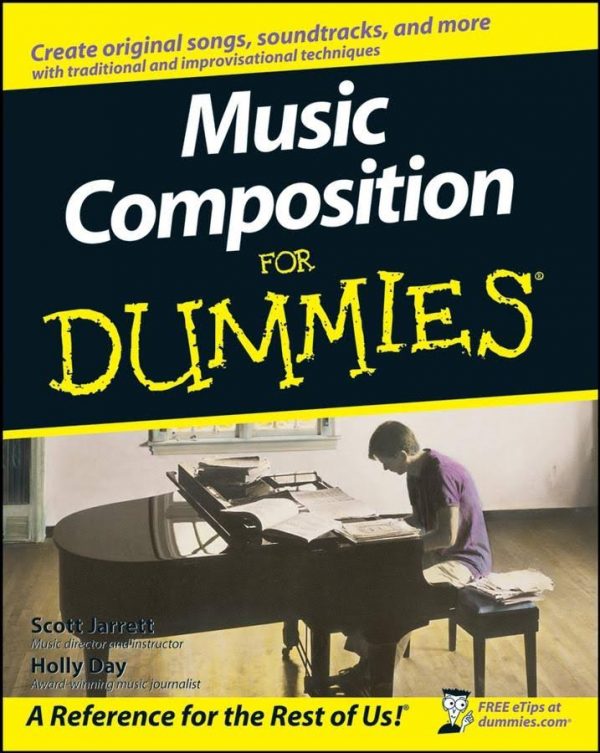
Both of them will bring you to the world of music theory in a friendly way, and both of them will do it with a reasonable sense of humour.
There is a lot of other decent books on music theory which you can search for on the internet. The important thing which is worth keeping in mind is that you do it for practical reasons. The more you practise in writing music, the sooner you acquire the craft. The better craftsmanship you possess, the more exquisite pieces of art you create. I should also mention that there are plenty of online courses in music theory today, both free and paid, where you can revise your music theory craft and discover the areas on which you may decide to work more. I will avoid any links to such courses here unless I decide to launch my own. However, please feel free to mention any online music theory course in the comments below in case you have positive experience, or if you have another justified reason to recommend them to beginning composers.