Starting with the first day of studying music, a student deals with creation. To write a dictation, to finish a melody, to do an exercise in harmony, to orchestrate several bars, in all cases the person touches the world of creation in music. While relatively fast for some people, or relatively slow for others, the world of music becomes closer. With every exercise, this world allows the person to approach it quicker and to get accustomed to its rules and ways of expression.
It is hard to say at which moment inspiration visits the learner. Some learners have it from the very beginning, others do not realise it unless told. Following its meaning, inspiration fills musicians with the air of art and creativity and enlightens the path on the way to their mission.
Among the meanings of the word ‘inspiration’, dictionaries write about ‘a divine influence or action on a person believed to qualify him or her to receive and communicate sacred revelation’ (www.merriam-webster.com). Indeed, a lot of music seems to come from another world (we shall omit the attribute ‘sacred’ here and will write about inspiration as an absolute value). Frederic Chopin was said to keep a feather pen and paper on his nightstand in order to be able to immediately write down the music which he could hear in his dreams. In the world of fiction, Charles Dickens used to say that at one moment of his life he was forced to write a novel because of the imaginable characters who were standing around him and making him describe their stories. The world of art is full of examples when painters and composers successfully embodied their visions on canvases and paper.
There is no definite verification of where this inspiration comes from. Every person may have his own experience and his own answer. Perhaps we should wait until physicists will further develop their Theory of Everything, and then we’ll have a more scientific approach to the problem. Meanwhile, I will share my understanding of this phenomenon.
Milestones
There are several names and several ideas which contributed to my understanding of the nature of inspiration. I came across most of these randomly in my life, however, I decided to put them in a chronological order here, exclusively for your convenience. It is hard to write about the achievements of a person in just a few words, so I will only mention the facts which helped me get my picture of the phenomenon.
Vladimir Vernadsky (1863-1945)
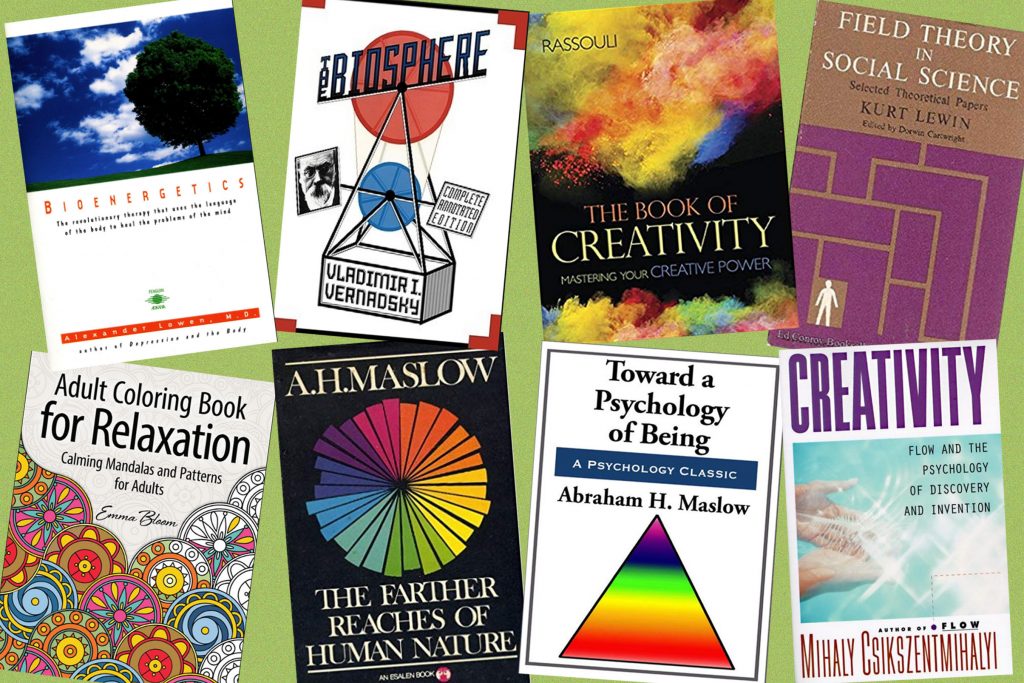
A scientist widely acknowledged in Russian speaking countries, the founder of the Ukrainian Academy of Sciences, Vladimir Vernadsky developed geochemistry, biogeochemistry and radiogeology and studied the role of geosphere in the development of the biosphere of Earth. Having been interested in the ancient Hinduism texts and sacred knowledge of Rig Veda, Vernadsky nevertheless stuck to the scientific approach of the development and the perspectives of life on the planet. He proposed a holistic view on the processes in which human beings were involved and declared Noosphere – the sphere of human thoughts – to be the next natural step of the planet’s development. Vernadsky considered all of the three phases of the planet’s development – geosphere, biosphere and noosphere – being natural processes, and stressed the responsibility of the humanity for the future of the planet. With the World Wide Web being introduced more than forty years after his death, Vernadsky thought of the planet and the humanity globally and predicted that the sphere of knowledge produced by human thoughts would be an active power in transforming the life on Earth.
Key word: Noosphere
Wilhelm Reich (1897-1957)
The assistant of Sigmund Freud in his clinics in Vienna, Wilhelm Reich further developed Freud’s theory of psychoanalysis. A researcher who was far ahead of his time, Reich was interested in a wide range of phenomena. Modern psychologists consider him the founder of body-oriented psychotherapy and the first psychologist who admitted the existence of bioenergy in a human body. Even if not all of his methods were considered scientific by his contemporaries, a lot of his ideas were picked up and developed further by other psychologists in the 20th century. One of Reich’s ideas, which is widely developed today by practising psychologists and psychotherapists, is about the natural energy flow in a human body as an attribute of a healthy organism.
Key words: Energy flow
Abraham Maslow (1908-1970)
Widely acknowledged for his hierarchy of human needs and the notion of self-actualisation, the founder of transpersonal psychology and positive psychology, Abraham Maslow described creativity as ‘an epiphenomenon of the greater wholeness and integration’ with further reference to self-acceptance. According to Maslow, creativity is a ‘constructive, synthesizing, unifying and integrative part of the inner integration of the person.’ Beginning with physiological needs and going through safety and social belonging, Malow’s hierarchy is crowned by self-esteem and self-actualisation, with creativity being an integral and natural part of the latter. In his later years, Maslow came to the idea of self-transcendence, a further need of a human being which refers to spirituality and the human consciousness of the highest level.
Key word: Creativity
Alexander Lowen (1910-2008)
The student of Wilhelm Reich, Alexander Lowen is known for his research in body-mind psychology and the development of bioenergetic analysis. He was one of the first psychologists of his time who introduced the concept of grounding as the required condition for a healthy flow of energy throughout the body. The concept of bioenergy, energy flow and grounding, being so natural to the Eastern school of philosophy and practical medicine, found its way into the West European school of psychotherapy and psychology. With a certain lack of scientifically acceptable explanation of the phenomenon, the statistical data and the effectiveness of the applied methods gave way to further development in this direction.
Key word: Grounding
I must admit that it is not only books in psychology that formed my understanding of the nature of inspiration. There is quite a number of books of another sort, the books which do not try to explain the processes from the scientific point of view, as we understand it according to the Western tradition, but describe these processes and reveal the ways to broaden our knowledge about the universe. Some of these books come from ancient times, others were published recently. Most of them have roots in Eastern philosophy and practices. You can search for the author, the language and the direction which resonate best with the way you percept life and music and build your own concept. I refer to psychology as to one of the few contemporary sciences which has made a huge step to understanding and making use of some really important but still unveiled processes of human life.
Music Field
I deliberately pointed out the key words in the previous section of the article. For me they are the guidelines which gradually brought me to the concept of the music filed. My approach to the problem of inspiration in music is also formed in connection with this concept. According to it, music presents a multidimensional field which is a part of the noosphere (instead of field you can use world, substance, space, area, or whatever brings you closer to the point). The multidimensional character of this field makes it possible to perceive music as something existing beyond the human being (the way I percept it), or inside the human being (many composers like to listen to the silence inside them before they start the process of writing music). With this approach we can speak of a composer as of a person with the unique ability to channel the world of music into our conventional life, the ability being inherent or trained.
The skill of notating what you perceive comes here to the fore. It would be interesting to explore whether people with poor notating or orchestrating abilities can ‘hear’ really complex music. Judging from myself, it looks like they can. I could ‘listen’ to really saturated symphonic pieces at the age of ten, when I knew neither of clefs, nor of transposing instruments. Perhaps it’s not the ability to notate, but the quality of the whole body’s vibrations which let you ‘hear’ the corresponding part of the music field.
However, the process of composing is not just channelling. It includes intention, request, concentration, realisation, orchestration, and other processes and skills adherent to the process of creation. In short, you should be ready – both physically and mentally – to perceive and notate (or record with the help of a DAW) the music flow which you request for your current purpose. It is helpful to treat yourself as an instrument which should always be tuned and ready for action.
At the beginning of this article I decided to write about inspiration as an absolute value. In fact, speaking about music as a multidimensional field, it is impossible to divide it into good and bad either. Music consists of vibrations, so instead of speaking about music itself, it would be only fair to consider the effect the vibrations produce on a listener. From this point of view, music vibrations – as any other vibrations – can be destructive, supportive, and even healing. It is not the aim of this article to find the ways to evaluate music, however, this approach can cool down for some time the disputes about good and bad music.
Practical consequences
The concept of the music field being shortly described above has far-reaching practical consequences.
Firstly, since the music field is the substance a composer is happy to communicate with, he or she should practice the ways of communication. Quite a number of exercises can be used for this purpose: the above-mentioned grounding and energy flow, different types of meditation and relaxation, deliberate communication with the field may be used among others. Healthy and useful as they are by themselves, these exercises will help develop the art of communicating with the field of music when used in full awareness of the purpose.
Secondly, to have a response from the field of music, a composer should learn how to define an intention and formulate the exact request. The more accurate the request is, the more relative the response may be. Fortunately, or not, the request-response mechanism is a one-way street. You never respond to the field, but rather listen to the response. Try and learn to listen to this response in your own, unique way.
Thirdly, since we speak of music as of vibrations in their absolute value, we should abandon the idea of evaluating music as good or bad. It is the orchestration which may not be good enough, not the music which you hear as a response to your request. The response you get is in full accordance with the current vibrations of yourself, and we will not judge ourselves with the elementary scale of good or bad.
Fourthly, the music which will be written down by you and then performed will have vibrations which will either resonate with the listeners or not. Obviously, the greater number of listeners it will resonate with, the more popular it will become. However, extreme popularity may not be your intention. It is you who decide which vibrations you would like to produce by the music. Please do not forget to consider it before making a request.
Fifthly, for practical purposes you should train the skill of notating music regularly (Pyotr Tchaikovsky is said to have written several bars every day for this purpose). It does not only save you time when you have short deadlines. It helps you stay tuned and train your ability to quickly realise and use the necessary tools when you are ready to catch the flow and write the music down.
Sixthly, cultivate ecological thinking about what you request. If a person disseminates garbage, it will be easy for him to get buried under it some day. What would you like to bring to Earth by your music and for what purpose? Does it multiply suffering, or does it relieve pain? Is it purely for joy, or do you simply show your skills in orchestration? Is it for the purpose of your popularity, or is there something important that you would like to pass to other people? Again, it’s not about positive or negative. It’s more about either being egotistic or considering yourself as part of a holistic system. Think globally.
And, last but not least, develop your personality. Read books, listen to various music, visit new places, go to the museums. In other words, broaden your knowledge and widen your consciousness. Your music reflects your current vibrations, which in its turn reflect your current level of development. You will always be able to downgrade your vibrations when necessary, but there is no magic stick to instantly raise them.
Conclusion
Everything written above can be a good practical supplement to your knowledge of harmony and writing scores. Hopefully the above suggestions will help you better realise the process of composing and give you another perspective on the source of inspiration in your life.
It’s up to you to decide whether you will read the books of the authors which are mentioned in this article. Many of them are specific and will be challenging for a musician to comprehend, as they were challenging for me. I only shared my experience and gave you the names and the short descriptions to consider. The magic formula of inspiration has not been revealed yet, no matter how much research has been done. Still, most of musicians know the power of inspiration by experience, and it is another approach to this phenomenon which is worth considering on your life-time mission of bringing music to this world.